
Mazda 6 Owners Manual: Using Automatic Locking Mode (Some models)
Follow these instructions when using a child-restraint system, unless you are attaching a LATCH-equipped childrestraint system to the rear LATCH lower anchors. Refer to “Using LATCH Lower Anchor”.
NOTE
Follow the child-restraint system manufacturer's instructions carefully. If you are not sure whether you have a LATCH system or tether, check in the child-restraint system manufacturer's instructions and follow them accordingly. Depending on the type of child-restraint system, it may use LATCH system instead of seat belts or if the belt goes across the child's chest, may recommend against using automatic locking mode.
1. latched by pushing it back until it is fully locked.
2. Remove the head restraint. Refer to Head Restraints.
3. Secure the child-restraint system with the lap portion of the lap/shoulder belt. See the manufacturer's instructions on the child-restraint system for belt routing instructions.
4. To get the retractor into the automatic locking mode, pull the shoulder belt portion of the seat belt until the entire length of the belt is out of the retractor.
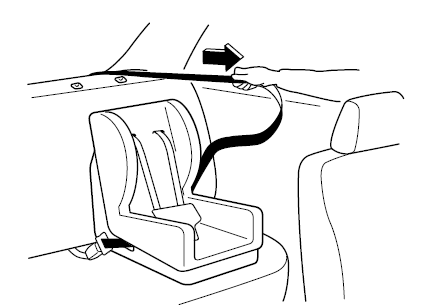
5. Push the child-restraint system firmly into the vehicle seat. Be sure the belt retracts as snugly as possible. A clicking noise from the retractor will be heard during retraction if the system is in the automatic locking mode. If the belt does not lock the seat down tight, repeat this step.
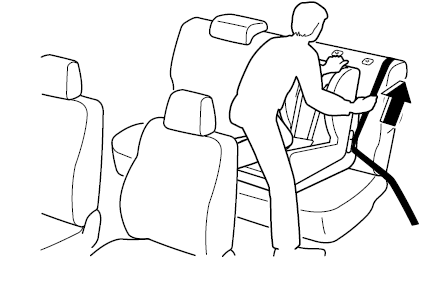
NOTE
Inspect this function before each use of the child-restraint system. You should not be able to pull the shoulder belt out of the retractor while the system is in the automatic locking mode. When you remove the child-restraint system, be sure the belt fully retracts to return the system to emergency locking mode before occupants use the seat belts.
6. If your child-restraint system requires the use of a tether strap, refer to the manufacturer's instructions to hook and tighten the tether strap.
WARNING
Use the tether and tether anchor only for a child-restraint system:
Using the tether or tether anchor to secure anything but a child-restraint system is dangerous. This could weaken or damage the tether or tether anchor and result in injury.
Always remove the head restraint and install child-restraint system:
Installing a child-restraint system without removing the head restraint is dangerous. The child-restraint system cannot be installed correctly which may result in death or injury to the child in a collision.
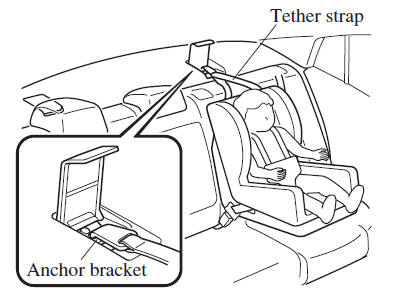
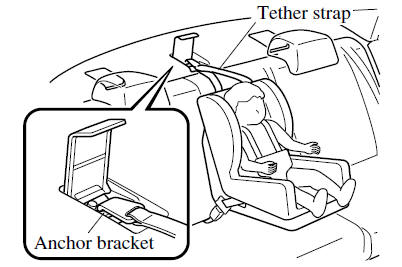
Always attach the tether strap to the correct tether anchor position:
Attaching the tether strap to the incorrect tether anchor position is dangerous. In a collision, the tether strap could come off and loosen the child-restraint system. If the childrestraint system moves it could result in death or injury to the child.
Always install the head restraint and adjust it to the appropriate position after removing the child-restraint system:
Driving with the head restraint removed is dangerous as impact to the occupant's head cannot be prevented during emergency braking or in a collision, which could result in a serious accident, injury or death. Refer to Head Restraints.
 Anchor Bracket
Anchor brackets for securing childrestraint systems are equipped in the vehicle.
Locate each anchor position using the illustration.
To install a child-restraint system, remove the head restraint. ...
 If You Must Use the Front Seat for Children
If you cannot put all children in the rear seat, at least put the smallest children
in the rear and be sure the largest child up front uses the shoulder belt over the
shoulder.
NEVER put a rear-f ...
Other materials:
Mazda 6 Owners Manual: Power brake unit inspection
Warning
The following inspection methods are the simple inspection methods
to judge the function of power brake.
If there is malfunction in power brake unit, replace the power
brake unit as a component.
Power Brake Unit Function Check (Simple Method)
Step 1
1. With the engine stoppe ...
Mazda 6 Owners Manual: Airflow mode actuator inspection
1. Connect battery positive voltage to terminal D or F and ground to terminal
F or D of the airflow mode actuator.
2. Verify that the airflow mode actuator operates as shown below.
If not as specified, replace the airflow mode actuator.
3. Verify that the resistance between the ter ...