
Mazda 6 Owners Manual: Battery Runs Out
Jump-Starting
Jump-starting is dangerous if done incorrectly. So follow the procedure carefully. If you feel unsure about jump-starting, we strongly recommend that you have a competent service technician do the work.
WARNING
 Follow These Precautions
Carefully:
To ensure safe and correct handling of the battery, read the following precautions carefully before using the battery or inspecting it.
 Do not allow the positive
( ) terminal to contact any other metal object that could cause sparks:
Flames
and sparks near open battery cells are dangerous. Hydrogen gas, produced during
normal battery operation, could ignite and cause the battery to explode. An exploding
battery can cause serious burns and injuries. When working near a battery, do not
allow metal tools to contact the positive (
 ) or negative (
 ) terminal of the battery.
 Keep all flames, including
cigarettes, and sparks away from open battery cells:
Flames and sparks near open battery cells are dangerous. Hydrogen gas, produced during normal battery operation, could ignite and cause the battery to explode. An exploding battery can cause serious burns and injuries.
Do not jump-start a frozen battery or one with a low fluid level: Jump-starting a frozen battery or one with a low fluid level is dangerous. It may rupture or explode, causing serious injury.
Connect the negative cable to a good ground point away from the battery:
Connecting the end of the second jumper cable to the negative (
) terminal of the discharged battery
is dangerous.
A spark could cause the gas around the battery to explode and injure someone.
Route the jumper cables away from parts that will be moving: Connecting a jumper cable near or to moving parts (cooling fans, belts) is dangerous. The cable could get caught when the engine starts and cause serious injury.
CAUTION
Use only a 12 V booster system. You can damage a 12 V starter, ignition system, and other electrical parts beyond repair with a 24 V power supply (two 12 V batteries in series or a 24 V motor generator set).
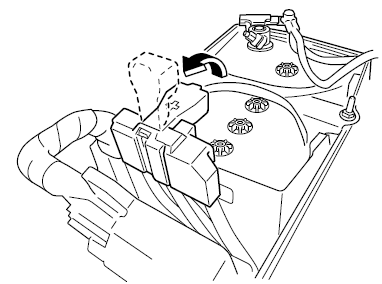
1. Remove the battery cover.
2. Make sure the booster battery is 12 V and that its negative terminal is grounded.
3. If the booster battery is in another vehicle, do not allow both vehicles to touch. Turn off the engine of the vehicle with the booster battery and all unnecessary electrical loads in both vehicles.
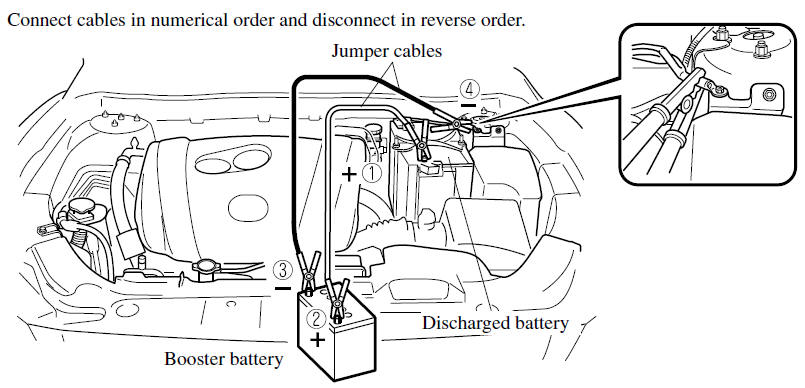
4. Connect the jumper cables in the exact sequence as in the illustration.
- Connect one end of a cable to the positive terminal on the discharged battery (1).
- Attach the other end to the positive terminal on the booster battery (2).
- Connect one end of the other cable to the negative terminal of the booster battery (3).
- Connect the other end to the ground point indicated in the illustration away from the discharged battery (4).
5. Start the engine of the booster vehicle and run it a few minutes. Then start the engine of the other vehicle.
6. (With i-ELOOP system)
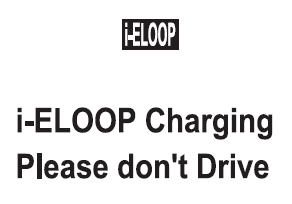
“i-ELOOP Charging Please don't Drive” is displayed in the multi-display of the instrument cluster after the engine is started. The message is no longer displayed when the engine is running and the charging is completed.
The vehicle may be driven after the message is no longer displayed.
NOTE
If the vehicle is driven while the message is displayed, a beep sound is heard. If you turn the steering wheel while the message is displayed, it will feel heavier than normal, but this does not indicate an abnormality. The steering operation will return to normal after the message is no longer displayed. Do not remove the jumper cables while the message is displayed.
7. When finished, carefully disconnect the cables in the reverse order described in the illustration.
8. If the battery cover has been removed, install it in the reverse order of removal.
NOTE
Verify that the covers are securely installed.
 Mounting the Spare Tire
1. Remove dirt and grime from the mounting surfaces of the wheel and hub, including
the hub bolts, with a cloth.
WARNING
Make sure the mounting surfaces of the wheel, hub and lug nuts are clean ...

Other materials:
Mazda 6 Owners Manual: Engine coolant
ENGINE COOLANT LEVEL INSPECTION
Verify that the coolant level in the coolant reservoir is between the F and L
marks.
If the engine coolant level is below L, remove the radiator cap and add
coolant. (See COOLING SYSTEM SERVICE WARNINGS.)
ENGINE COOLANT REPLACEMENT
Warning
Drain the ...
Mazda 6 Owners Manual: Transaxle range (tr) switch inspection
Operating Inspection
1. Verify that the starter operates only when the ignition switch is at the
START position with the selector lever in P or N position.
If not as specified, adjust the TR switch.
2. Verify that the back-up lights illuminate when shifted to R position with
the ignition ...