
Mazda 6 Owners Manual: Tire Maintenance
Improper or inadequate vehicle maintenance can cause tires to wear abnormally. Here are some important maintenance points:
Tire Inflation Pressure
Inspect all tire pressure monthly (including the spare) when the tires are cold. Maintain recommended pressures for the best ride, top handling, and minimum tire wear. Use the pressures specified on the vehicle tire information placard or tire label for optimum service.
Tire Rotation
To equalize tread wear, rotate the tires every 12,000 km (7,500 miles) at the latest or sooner if irregular wear develops. Mazda recommends to rotate every 8,000 km (5,000 miles) to help increase tire life and distribute wear more evenly.
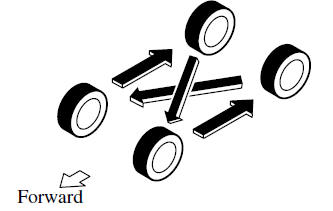
Do not include (TEMPORARY USE ONLY) spare tire in rotation.
Inspect the tires for uneven wear and damage. Abnormal wear is usually caused by one or a combination of the following:
- Incorrect tire pressure
- Improper wheel alignment
- Out-of-balance wheel
- Severe braking
After rotation, inflate all tire pressures to specification and inspect the lug nuts for tightness.
After adjusting the tire pressure, initialization of the tire pressure monitoring system is necessary to make the system operate normally.
CAUTION
Rotate unidirectional tires and radial tires that have an asymmetrical tread pattern or studs only from front to rear, not from side to side. Tire performance will be weakened if rotated from side to side.
Replacing a Tire
WARNING
Always use tires that are in good condition:
Driving with worn tires is dangerous. Reduced braking, steering, and traction could result in an accident.
If a tire wears evenly, a wear indicator will appear as a solid band across the tread. Replace the tire when this happens.
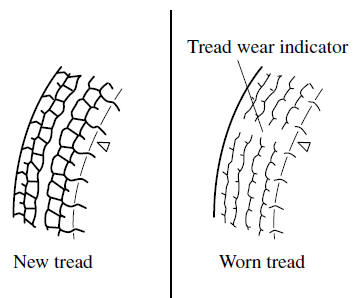
You should replace the tire before the band crosses the entire tread.
After adjusting the tire pressure, initialization of the tire pressure monitoring system is necessary to make the system operate normally.
NOTE
Tires degrade over time, even when they are not being used on the road. It is recommended that tires generally be replaced when they are 6 years or older. Heat caused by hot climates or frequent high loading conditions can accelerate the aging process. You should replace the spare tire when you replace the other road tires due to the aging of the spare tire. The period in which the tire was manufactured (both week and year) is indicated by a 4-digit number.
Safety Practices
The way you drive has a great deal to do with your tire mileage and safety. So cultivate good driving habits for your own benefit.
- Observe posted speed limits and drive at speeds that are safe for the existing weather conditions
- Avoid fast starts, stops and turns
- Avoid potholes and objects on the road
- Do not run over curbs or hit the tire against the curb when parking
CAUTION
If you feel a sudden vibration or ride disturbance while driving or you suspect your tire or vehicle has been damaged, immediately reduce your speed. Drive with caution until you can safely pull off the road. Stop and inspect the tire for damage. If the tire is under-inflated or damaged, deflate it, remove the tire and rim and replace it with your spare tire. If you cannot detect a cause, have the vehicle towed to the nearest vehicle or tire dealer to have the vehicle inspected.
 Glossary of Terms
Tire Placard:
A label indicating the OE tire sizes, recommended inflation pressure, and the maximum weight the vehicle can carry.
Tire Identification Number (TIN):
A number on the sidewall of each ...
 Vehicle Loading
WARNING
Do not tow a trailer with this vehicle: Towing a trailer with this
vehicle is dangerous because it has not been designed to tow a trailer and doing
so will affect the drive system which c ...
Other materials:
Mazda 6 Owners Manual: Neutral switch inspection
Note
Perform the following inspection only when directed.
Continuity Inspection
1. Disconnect the negative battery cable.
2. Remove the neutral switch.J5 MANUAL TRANSAXLE REMOVAL/INSTALLATION.)
3. Inspect for continuity between the neutral switch terminals using an
ohmmeter.
If the n ...
Mazda 6 Owners Manual: Parking in an Emergency
The hazard warning lights should always be used when you stop on or near a roadway
in an emergency.
The hazard warning lights warn other drivers that your vehicle is a traffic hazard
and that they must take extreme caution when near it.
Depress the hazard warning flasher and all the turn s ...