
Mazda 6 Owners Manual: Smart City Brake Support (SCBS)
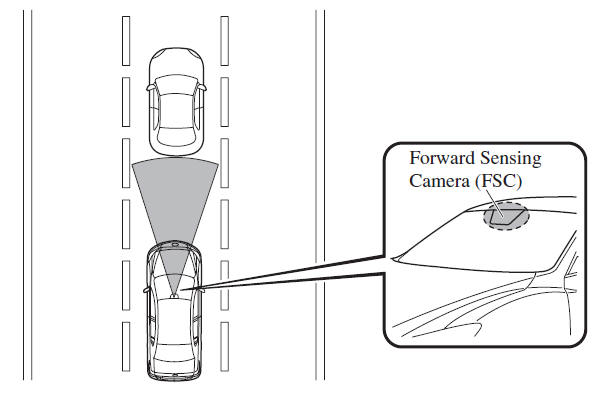
The Smart City Brake Support (SCBS) system alerts the driver of a possible collision using an indication in the display and a warning sound when the Forward Sensing Camera (FSC) detects a vehicle ahead and determines that a collision with a vehicle ahead is unavoidable while the vehicle is being driven at a vehicle speed of about 4 to 80 km/h (2 to 50 mph). In addition, the system reduces damage in the event of a collision by operating the brake control (SCBS brake) when the system determines that a collision is unavoidable while the vehicle is being driven at a vehicle speed of about 4 to 30 km/h (2 to 18 mph). It may also be possible to avoid a collision if the relative speed between your vehicle and the vehicle in front of you is less than about 20 km/h (12 mph). In addition, when the driver depresses the brake pedal while the system is in the operation range at about 4 to 30 km/h (2 to 18 mph), the brakes are applied firmly and quickly to assist. (Brake Assist (SCBS brake assist))
WARNING
Do not rely completely on the Smart City Brake Support (SCBS) system:
- The Smart City Brake Support (SCBS) system is only designed to reduce damage in the event of a collision. Over reliance on the system leading to the accelerator pedal or brake pedal being mistakenly operated could result in an accident.
- The Smart City Brake Support (SCBS) is a system which operates in response to a vehicle ahead. The system may not be able to detect or react to 2-wheeled vehicles or pedestrians.
CAUTION
When driving off-road in areas where there is dense grass, it is recommended that the Smart City Brake Support (SCBS) system be turned off.
In the following cases, turn the system off to prevent a mis-operation:
- The vehicle is being towed or when towing another vehicle.
- The vehicle is on a chassis roller.
- When driving on rough roads such as in areas of dense grass or off-road.
NOTE
- The Smart City Brake Support (SCBS) system will operate under the following
conditions.
- The engine is running.
- “Smart City Brake Support Malfunction. Forward SCBS Disabled.” is not displayed in the multi-information display. (with multi-information display)
- The Smart Brake Support/Smart City Brake Support (SBS/SCBS) system warning indication/warning light (amber) does not illuminate.
- (Rear-end collision warning)
The vehicle speed is about 4 to 80 km/h (2 to 50 mph).
- (Brake control (SCBS brake))
The vehicle speed is about 4 to 30 km/h (2 to 18 mph).
- The Smart City Brake Support (SCBS) system is not turned off.
- Under the following conditions, the Smart City Brake Support (SCBS) system
may not operate normally:
- The Smart City Brake Support (SCBS) system will not operate if the driver is deliberately performing driving operations (accelerator pedal and steering wheel).
- If there is the possibility of partial contact with a vehicle ahead.
- The vehicle is driven on a slippery road surface such as wet roads or icy or snowbound roads.
- The braking performance is adversely affected due to cold temperatures or wet brakes.
- The vehicle is driven at the same speed as the vehicle ahead.
- The accelerator pedal is depressed.
- The brake pedal is depressed.
- The steering wheel is being operated.
- The selector lever is being operated.
- In the following cases, the Forward Sensing Camera (FSC) determines that
there is a vehicle ahead and the Smart City Brake Support (SCBS) may operate.
- Objects on the road at the entrance to a curve.
- Vehicles passing in the opposite lane while making a curve.
- Metal objects, bumps, or protruding objects on the road.
- When passing through a toll gate.
- When passing through low gates, narrow gates, car washing machines, or tunnels.
- If you suddenly come close to a vehicle ahead.
- 2-wheeled vehicles, pedestrians, animals or standing trees.
- Vehicle is driven with some of the tires having significant wear.
- (Manual transaxle)
If the vehicle is stopped by the SCBS operation and the clutch pedal is not depressed, the engine stops.
- Smart City Brake Support (SCBS) Indicator Light (Red) (Type B Instrument Cluster)
- Collision Warning
- Automatic Brake Operation Display (Type A Instrument Cluster)
- Stopping the Smart City Brake Support (SCBS) System Operation
 Lane Departure Warning
If the system determines that the vehicle may deviate from its lane, the lane
departure warning (beep sound, rumble sound*1, or steering wheel vibration) is activated
and the direction in which th ...
 Smart City Brake Support (SCBS) Indicator Light (Red) (Type B Instrument Cluster)
If the Smart City Brake Support (SCBS) is operating, the indicator light (red)
flashes.
...
Other materials:
Mazda 6 Owners Manual: Rear door removal/installation
Warning
Handling the side air bag sensor improperly can accidentally
deploy the side air bag module, which may seriously injure you. Read AIR BAG
SYSTEM SERVICE WARNINGS before working around the B-pillar areas. (See
SERVICE WARNINGS.)
Note
The side air bag sensor is located in t ...
Mazda 6 Owners Manual: Remote handle lever removal/installation
4SD
1. To remove the remote wire, remove the trunk side trim.
2. Remove in the order indicated in the table.
3. Install in the reverse order of removal.
5HB
1. To remove the remote wire, remove the trunk side upper trim and trunk side
trim.
2. Remove in the order indicated in the table.
...